


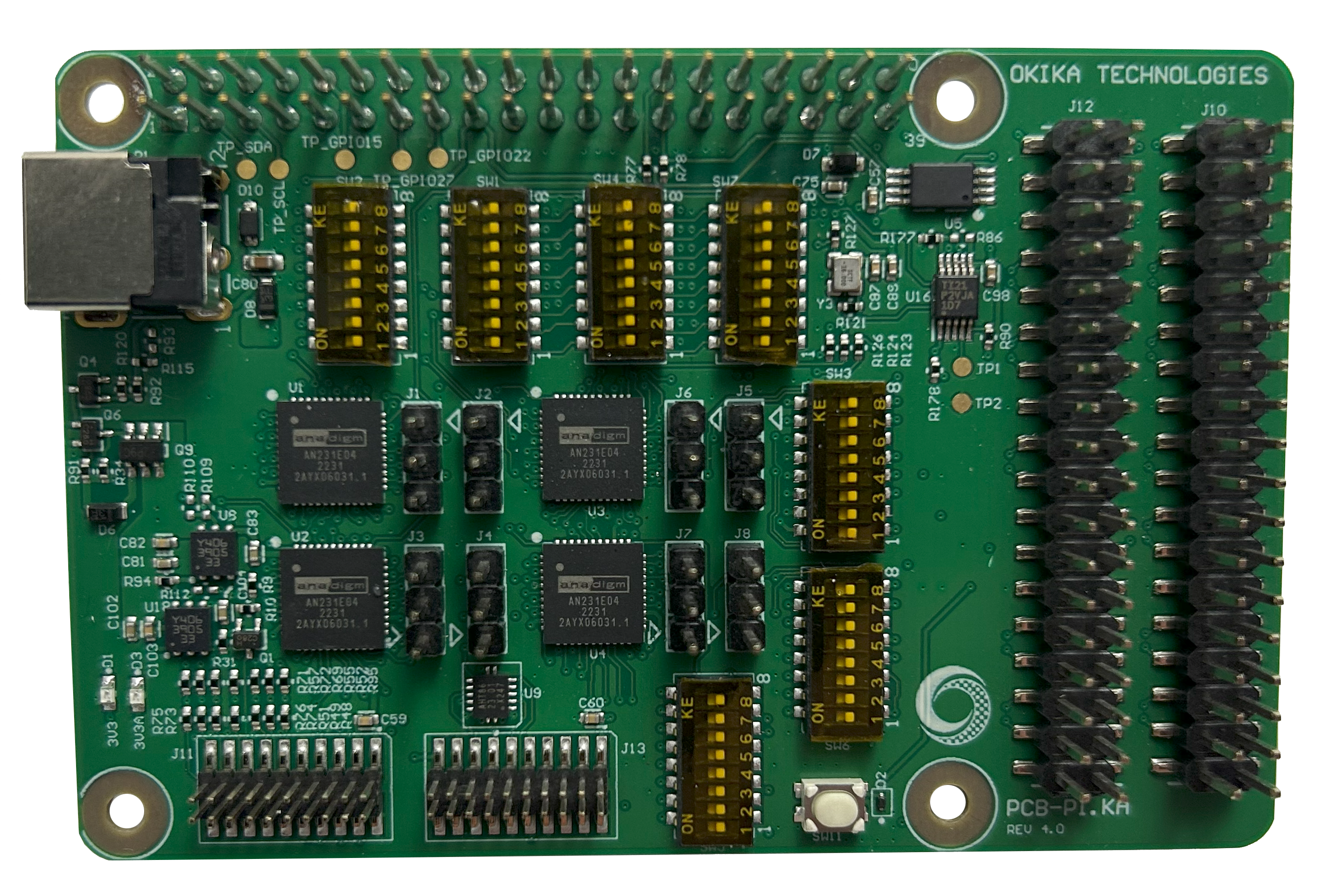
OTC2310K04-PIKA Raspberry Pi HAT with 4 AN231E04 Chips
$156.00
OTC2310K04-PIKA
Raspberry Pi HAT Development Board incorporating 4 FlexAnalog™ Field-Programmable Analog Array (FPAA) Integrated Circuit Components
Order Quantity: 1
OTC2310K04-PIKA Raspberry Pi HAT with 4 AN231E04 Chips
$156.00
The PIKA board simplifies multi-channel analog prototyping. With four independent FPAAs and flexible routing via onboard switches, it’s ideal for building signal-processing architectures directly on your Pi.
Featured Highlights
- Quad AN231E04 FPAAs: Individually programmable analog arrays with flexible signal paths.
- Pi HAT Interface: Native 2x20 header for plug-and-play integration with Raspberry Pi.
- SPI Configuration Interface: Fast transfer of FPAA configuration data from host systems.
- Direct Digital I/O Access: Dedicated IO5P and IO5N connections from each FPAA to the Pi header.
- Differential Rauch Filters: Eight onboard analog input filters for signal conditioning and experimentation.
- Onboard Routing Switches: Configure chip-to-chip signal paths without external jumpers.
- Customizable Signal Routing: 0-ohm jumper pads enable advanced routing and hardware modifications.
- Flexible Clock Architecture: Switch between the onboard 16 MHz oscillator and Raspberry Pi supplied clocks.
- Daisy-Chaining & Stackable Design: Expand systems with multiple interconnected PIKA boards.
- Breadboarding Headers: Dual 2×18 headers provide convenient access to analog and digital signals.
- Dual Power Options: Automatic selection between Raspberry Pi power and an external 7–12V supply.
- Customizable HAT EEPROM: Unprogrammed HAT ID EEPROM available for user-defined configurations.
- Open Source Python Tooling: GitHub support with the Pikapy example project for programming and control.
Technical Specifications
| Featured Chip | AN231 |
|---|---|
| Number of FPAAs | 4 |
| Number of CABs | 4 |
| Power Supply | Pi Header or External |
| ADC Resolution | 8 |
| ADC Data Rate | 250ksps |
| Input Filters | 8x Rauch, 23kHz |
| Interface | SPI |
| Microcontroller | External Pi |
| Clock Source | 16 MHz on-board, External |
FAQs
Is this board compatible with all Raspberry Pi models?
The OTC2310K04-PIKA board is designed to work with Raspberry Pi models featuring the standard 2x20 GPIO header. Compatibility may vary with newer Pi models that change this interface, so please check the specific model before use.
Can I use this board with Arduino or other microcontrollers?
Yes, the OTC2310K04-PIKA board can work with Arduino and other microcontrollers, but it only supports 3.3V I/O. Since many Arduino boards use 5V I/O, you’ll need external level shifting.
What’s the benefit of having four FPAAs on one board?
Four FPAAs allow for parallel processing of multiple analog signal channels, enabling complex multi-channel analog designs and more flexible system architectures.
How is power managed on this board?
The board supports dual power options and can be powered either through the Raspberry Pi’s GPIO header or an external supply. It includes automatic selection and onboard regulation to provide stable +3.3V rails.
Is stacking multiple PIKA boards supported?
Yes, the board supports daisy-chaining and vertical stacking to expand the number of FPAAs and increase system complexity.
Does the board include a clock or rely on the host?
The board includes a 16 MHz onboard analog master clock and also supports using an external clock source from a Raspberry Pi.
Architecture

OTC2310K04-PIKA Block Diagram
Programming:
The board is programmed by exporting .ahf configuration files from Anadigm Designer 2, which are then transferred to the PIKA via the SPI interface. A sample Python project for programming and configuring the board is available on GitHub:
https://github.com/okikajre/pikapy
PiKa Board User Access & Control Points

PiKa Board Header Pinout

PiKa Board Analog Header

PiKa Board Switches