


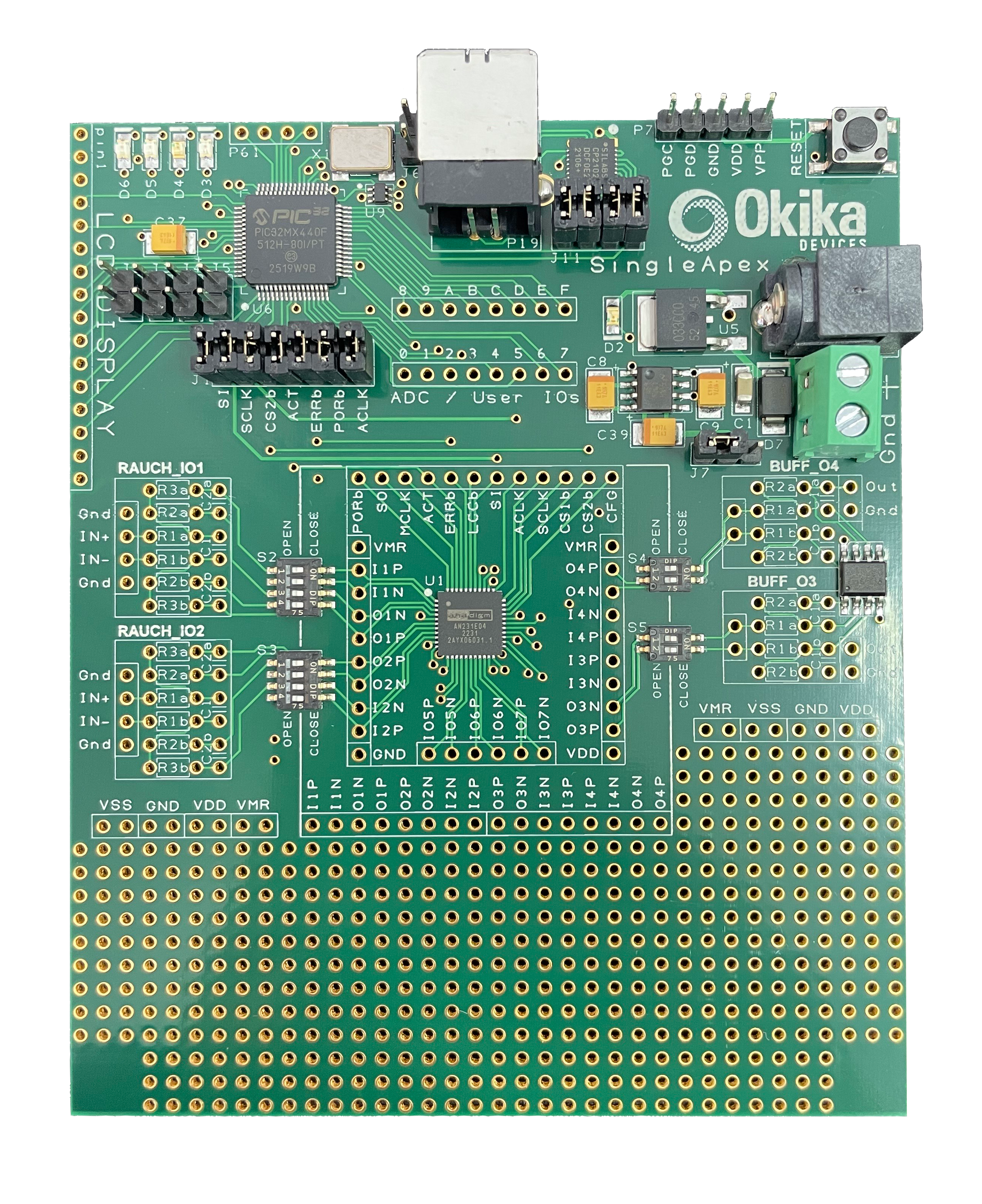
AN231K04-SING1 Single FlexAnalog™ FPAA Development Board
$156.00
AN231K04-SING1
The AN231K04-SING1 is a development board with one (1) AN231E04 chip, power supply, programming circuitry, and prototyping space. This single development board is fully supported by AnadigmDesigner2 Software enabling designs with increased channel count or additional filter stages.
Order Quantity: 1
AN231K04-SING1 Single FlexAnalog™ FPAA Development Board
$156.00
The AN231K04-SING1 board is built for fast prototyping of embedded analog systems. With a single AN231E04 FPAA, integrated PIC32 microcontroller, and full access to configurable I/O and filters, it provides a versatile and self-contained platform for development.
Featured Highlights
- Single AN231E04 FPAA – Full-featured FPAA device for analog signal processing.
- Integrated PIC32 Microcontroller – 32-bit MCU with USB interface, 16x 10-bit ADCs, and reprogrammable via 5-pin header.
- Configurable Analog Filters – Onboard Rauch low-pass input filters and buffered output stages.
- Breadboard Area – Tinker freely with added components and layout flexibility.
- Full FPAA Pin Access – Debug and prototype directly with labeled access points.
- Analog & Digital Isolation – Electrically decouple sections for cleaner analog performance.
- Versatile Power Options – Operates on +4V to +9V input, generates ±3.3V rails internally.
- Self-Configuring Capability – Stores test circuits in FLASH for autonomous bootup.
Technical Specifications
| Number of FPAAs | 1 |
|---|---|
| Number of Cores | 4 |
| Power Supply | External |
| ADC Resolution | 8 |
| ADC Data Rate | 250ksps |
| DAC Resolution | 8 |
| Input Filters | 2x Rauch 490kHz, 23kHz |
| Differential to Single-Ended Converter | 2x 480kHz, 23kHz |
| Interface | USB |
| Microcontroller | PIC32 |
FAQs
Can this board be powered from a USB port?
No, the board requires a +4 to +9V external power source. It has onboard regulation for +3.3V.
Do I need a programmer to use the PIC32?
No programmer is required for most use cases, but a 5-pin header is available if you wish to reprogram the PIC32 firmware directly.
Can I use this board without the PIC32, using my own MCU or system?
Yes, the FPAA can be used independently. The board gives you access to all relevant pins, and you can bypass or isolate the PIC32 section.
Are the Rauch filters active or passive?
The Rauch input filters are passive and can provide single-ended to differential conversion in addition to low-pass filtering.
How does this board handle differential-to-single-ended conversion and filtering?
The optional output buffer stage converts the FPAA’s differential outputs to single-ended signals for easier interfacing with external measurement or processing circuitry. It can also include optional low-pass filtering to reduce noise and improve signal integrity.
How do I store and recall configurations?
The board allows FLASH-based configuration storage and can boot with a saved circuit automatically.
What’s the best clock speed to use for general applications?
Most users start with 16MHz. External clocks up to 40MHz can be used, but the system clock dividers must keep the on-chip system clock at 16MHz or below.