Datasheet
OTC2312_FPAA_Shield.pdf
Software
AnadigmDesigner®2
Help & Support Docs
FlexAnalog™ Help & Support Docs

The OTC2312 FlexAnalog™ FPAA Shield provides a convenient platform for exploring software-defined analog signal processing using the AN231E04 Field Programmable Analog Array (FPAA). Designed in the Arduino Uno shield form factor, it integrates the analog front end, power supplies, signal conditioning circuitry, and SPI interface needed to rapidly develop and evaluate programmable analog systems. The shield supports one or two analog signal channels and can be used with Arduino Uno boards as well as other popular microcontroller platforms including ESP32, Raspberry Pi, and BeagleBone.

Using Okika Designer software, engineers can build analog circuits from a library of 43 Configurable Analog Modules (CAMs), including filters, amplifiers, oscillators, comparators, and signal conditioning blocks.

A key advantage of FlexAnalog™ technology is the ability to update an entire circuit configuration simultaneously, enabling smooth real-time adaptation for applications such as sonar time-varied gain (TVG), automatic gain control (AGC), adaptive filtering, sensor signal conditioning, and programmable audio effects. With its fully differential signal path, onboard ±3.3V supplies, and flexible connectivity options, the OTC2312 is well suited for education, research, prototyping, and product development.

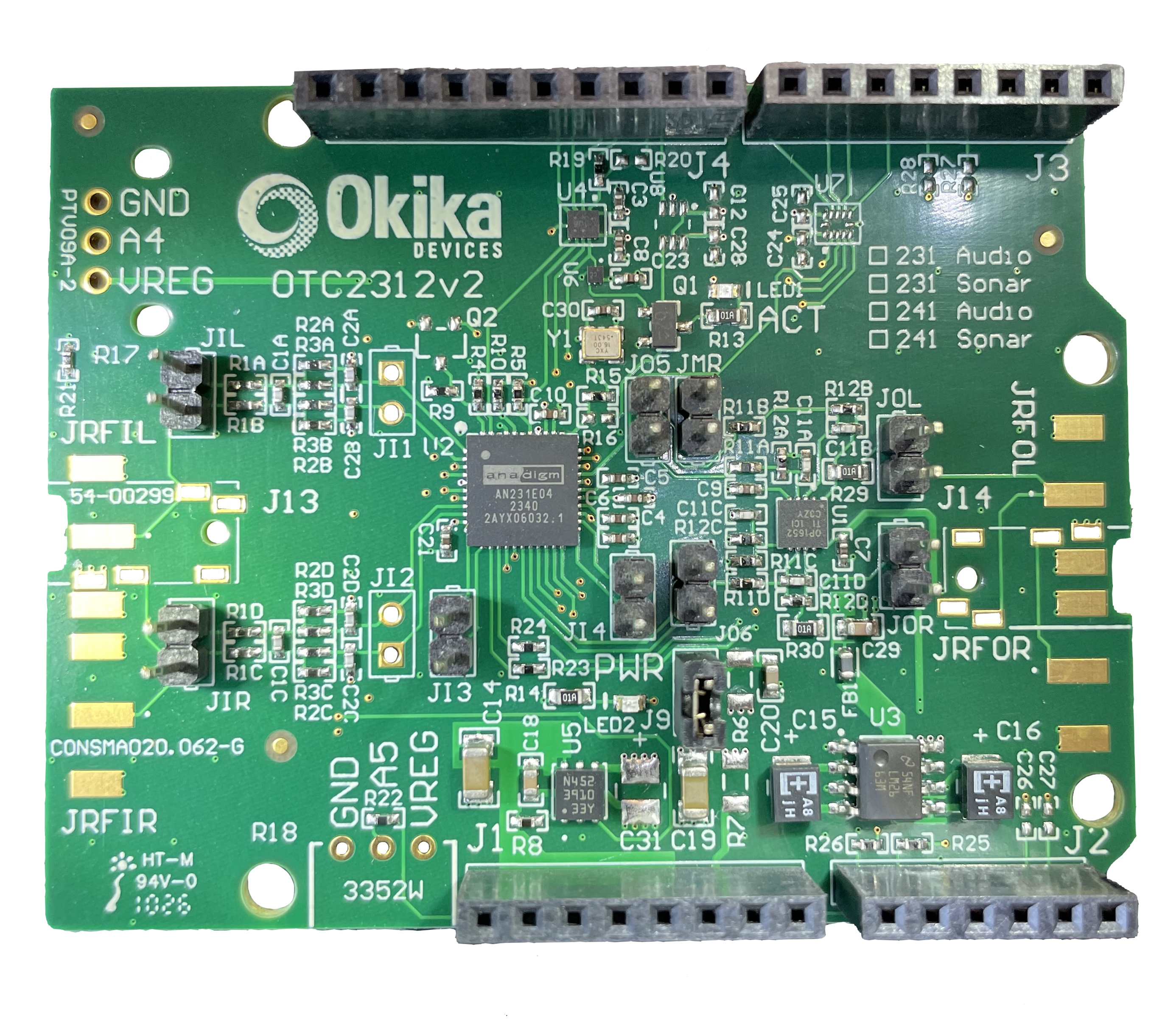
Key Features

  • AN231E04 Field Programmable Analog Array (FPAA)
  • Arduino Uno compatible shield form factor
  • Stackable design for use with additional Arduino shields
  • Supports analog signals up to 400 kHz
  • Dual-channel analog signal processing
  • Fully differential internal signal path
  • Ground-referenced single-ended analog inputs
  • Buffered single-ended analog outputs
  • Integrated Rauch filter input circuitry
  • 16 MHz onboard clock source
  • Onboard 3.3V regulator and -3.3V charge pump
  • 5V to 3.3V SPI level shifting
  • Optional SMA and 3.5 mm audio connectors
  • Potentiometer footprints for user controls
  • FPAA current monitoring header
  • Real-time reconfigurable analog circuits via SPI

FAQs

What microcontrollers are compatible with the OTC2312?

The shield is designed for Arduino Uno compatibility but can also be used with ESP32, Raspberry Pi, BeagleBone, and other microcontroller platforms that provide a compatible SPI interface and appropriate I/O voltage levels.

Can the analog circuit be changed while the system is running?

Yes. The AN231E04 supports runtime reconfiguration. New parameters or entirely new circuit configurations can be loaded into shadow memory and activated simultaneously, enabling adaptive analog processing applications.

What types of analog circuits can be implemented?

Users can create filters, amplifiers, integrators, differentiators, oscillators, comparators, signal conditioners, automatic gain control systems, sensor interfaces, and many other analog functions using configurable analog modules.

What signal frequencies can the OTC2312 process?

The shield supports analog signals up to approximately 400 kHz when used with the AN231 FPAA architecture, making it suitable for audio, ultrasonic, instrumentation, and control applications.

Are audio and RF-style connectors supported?

Yes. The board includes footprints for stereo 3.5 mm audio jacks and SMA connectors, allowing users to select the interface best suited to their application.

Is the OTC2312 suitable for education and laboratory use?

Absolutely. The Arduino-compatible form factor, software-based analog design workflow, and extensive configurability make it well suited for teaching analog signal processing, laboratory experiments, and research projects.

What makes FlexAnalog™ technology different from conventional analog circuits?

Traditional analog circuits typically require hardware redesign to modify functionality. FlexAnalog™ FPAAs allow analog behavior to be changed through software, enabling rapid prototyping, adaptive systems, field updates, and multifunction analog hardware platforms.