


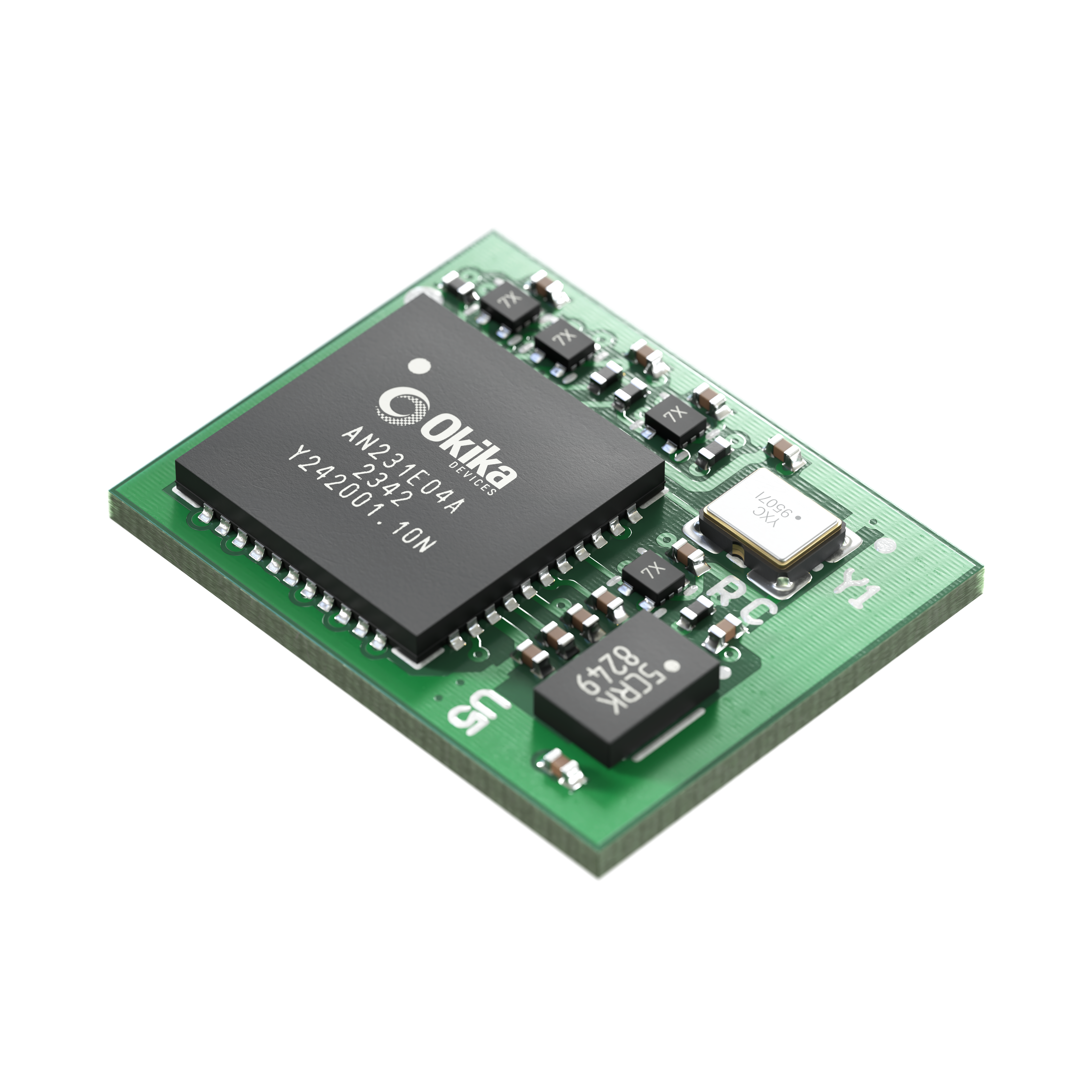

Chameleon™ 8th Order Butterworth Lowpass Filter
$25.00
OTC9310L
Precision 8th-order Butterworth low-pass filter modules built on FPAA technology, with characterized cutoff frequencies from 10 Hz to 100 kHz, differential signal paths, and production-ready performance.
Chameleon™ 8th Order Butterworth Lowpass Filter
OTC9310L (10Hz)
$25.00
The OTC931xL series are 8th-order Butterworth switched-capacitor low-pass filter modules based on the Okika Devices AN231E04 Field Programmable Analog Array (FPAA). An onboard EEPROM and internal clock configure the programmable IC as a fixed-function filter with characterized performance, with cutoff frequencies available from 10 Hz to 100 kHz. The Butterworth response provides a flat passband, no stopband ripple, and low ringing for step inputs.
An input amplifier allows ground-referenced signals to interface easily with the single-supply module using only a few passive components. A fully differential internal signal path improves common-mode rejection, maximizes dynamic range, reduces susceptibility to ground noise, and prevents offset accumulation through the cascaded filter stages. The differential outputs can connect directly to differential or single-ended ADCs. Additional frequency options and alternative filter topologies are available upon request or by programming the EEPROM of a Chameleon OTC9300L module.
FAQs
What’s the difference between a Standard Product and a Custom Product?
For a standard product, the configuration file and software circuit file is open-source and available to everyone. For a Custom Product, these files remain customer IP and are not shared. In both cases, the application-specific configuration file comes pre-loaded into the module EEPROM.
Can you reprogram the EEPROM on a Standard Product?
Yes. The SPI EEPROM write protect feature is used to protect against accidental reprogramming of the EEPROM, but intentional reprogramming is supported.
Can you reprogram the EEPROM in system?
Yes. However, if customers plan on reprogramming the module in-system, we recommend that they considering purchasing an FPAA chip, which would enable on-the-fly reprogramming with circuit update times measured in microseconds.
Why would a customer buy a module instead of an FPAA chip?
It’s already programmed and characterized. They can get the functionality you need without connecting it to a microcontroller. The HDI interconnect module compacts the circuitry into a smaller area than can be achieved with typical low-cost PCB technology.
When on-the-fly reconfiguration is needed, a FlexAnalog TM chip will perform better. In high-volume, cost-sensitive applications, a chip-based solution will likely provide lower cost for the same functionality.
Why are there so many pins on the module?
The fully differential signal path requires two pins per IO, and several pins are dedicated to programming. The same package is used for single and dual channel products.
How do you solder down the module?
Apply solder paste to the PCB footprint pads using a stencil and use IR reflow to reflow the paste. Solder joints on the module may reflow during assembly, but surface tension will keep the components in place as long as there is not excessive airflow or vibration.
Do not exceed 260°C reflow temperature.
Isn’t switched capacitor technology really noisy?
Clock feedthrough and time-step discretization are two sources of noise that are unique to switched capacitor circuits.
In most cases, the clock is at least 10x the frequency of the analog signals, allowing the clock feed-through to be filtered by a simple RC filter. Many standard products provide a spare IO amplifier that can be used to implement a second order Rauch filter to further suppress clock feedthrough and eliminate the stair-step appearance of the output.
The analog clock is provided as an output of the module so that the downstream ADC can be synchronized with the sample clock and avoid sampling the output during switching events.