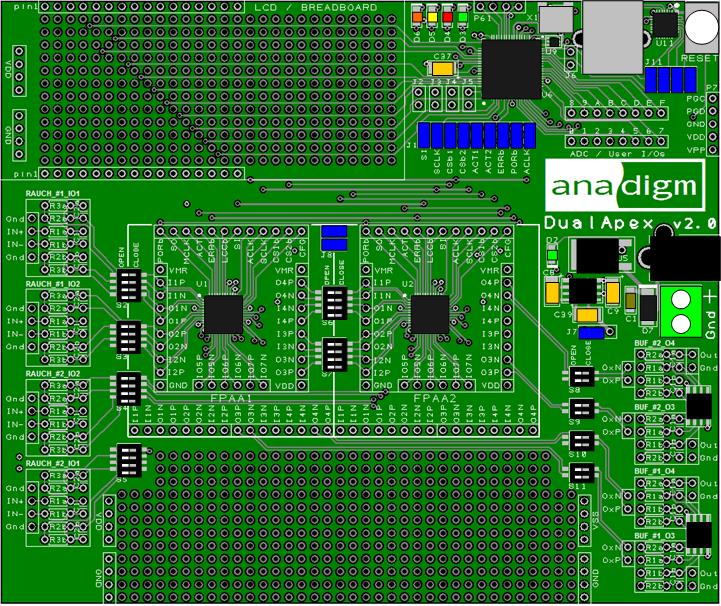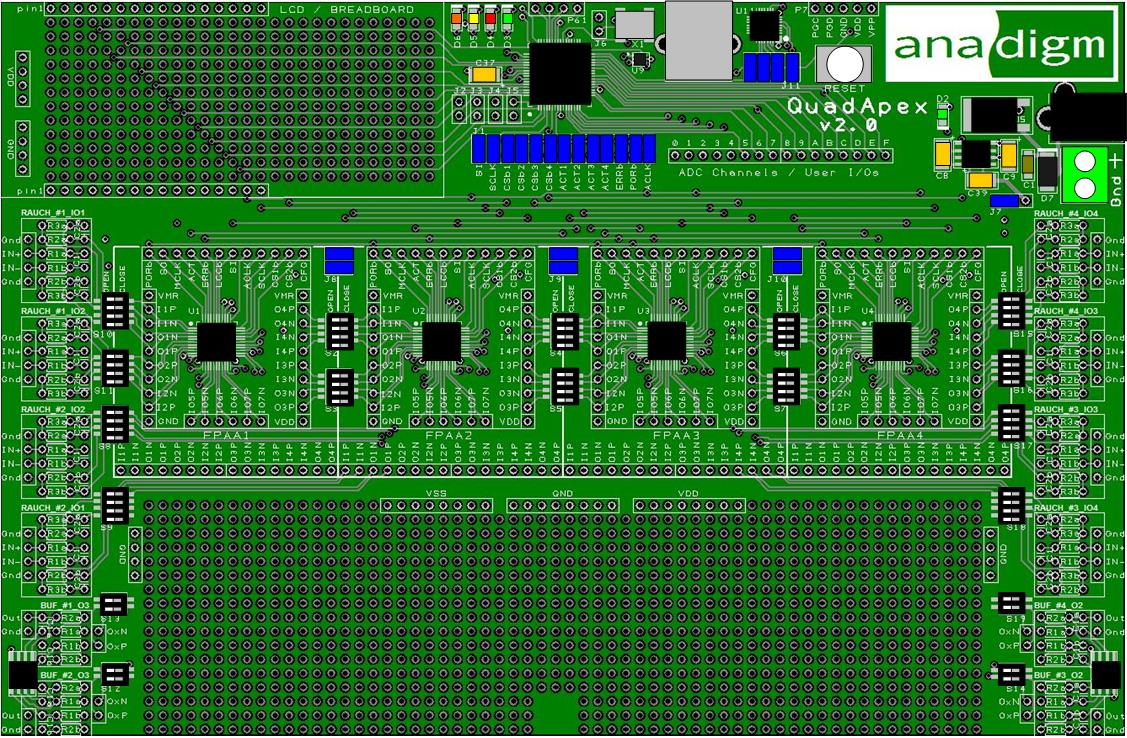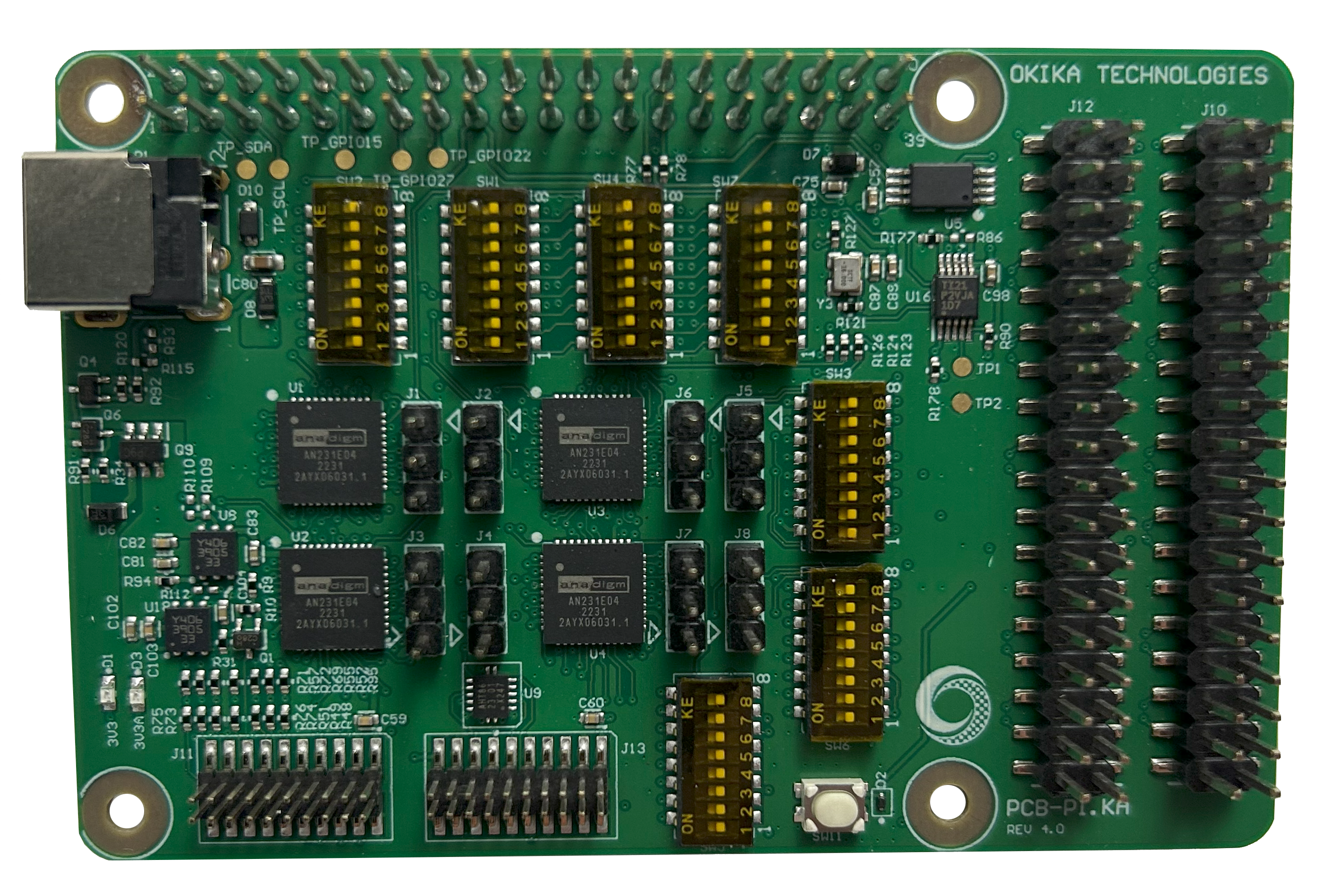
Most real products are not purely analog or purely digital. An FPAA often sits alongside a microcontroller, an FPGA, or both. The integration strategy determines whether the overall system feels cohesive or fragile.
Hybrid architectures work well when responsibilities are clearly defined and interfaces are engineered deliberately. They become unstable when signal domains and timing assumptions are blurred.
This article outlines practical considerations for integrating FPAAs into MCU- and FPGA-based systems.
Defining Architectural Boundaries
The first design decision is functional partitioning.
- In most successful systems:The FPAA handles continuous-time signal conditioning, filtering, gain control, or adaptive analog preprocessing.
- The MCU manages configuration, supervisory control, communication, and system-level logic.
-
The FPGA handles deterministic digital processing, high-speed data movement, or parallel computation.
Problems arise when roles overlap without clear intent. For example, attempting to implement precise timing-dependent digital state machines inside analog feedback paths increases complexity without clear benefit.
Define early:
-
What remains analog
-
What becomes digitized
-
Where feedback loops close
- Which device owns system timing
Once these boundaries are explicit, integration becomes straightforward.
Interfacing FPAA to an MCU
Most MCU integrations fall into two categories: configuration control and signal acquisition.
Configuration and Control
An MCU typically configures the FPAA over a serial interface and may adjust parameters during runtime. From a system perspective:
-
Validate configuration timing and startup order.
-
Ensure stable power and reference rails before programming.
- Characterize analog startup behavior after configuration.
Transient behavior during reconfiguration should be measured, especially if the FPAA output drives sensitive downstream circuitry.
Analog Signal Handoff to ADC
When routing FPAA outputs into an MCU’s ADC:
-
Match output swing to ADC input range.
-
Verify source impedance compatibility.
-
Consider adding a buffer if sampling transients disturb the analog node.
-
Confirm anti-alias filtering is adequate before conversion.
MCU ADCs often have input sampling capacitors that momentarily load the signal. If the FPAA output stage is not designed to drive that load, measurement results will vary with sampling rate.
Bench testing across multiple sampling frequencies quickly reveals this issue.
Interfacing FPAA to an FPGA
Integration with an FPGA typically involves one of three patterns:
-
FPAA performs analog preprocessing before high-speed ADC feeding the FPGA.
-
FPGA generates digital control signals that adjust FPAA parameters.
-
Closed-loop systems where FPGA logic depends on conditioned analog feedback.
Managing Analog to Digital Boundaries
In high-performance systems, the FPAA often improves signal quality before digitization. Proper integration requires:
-
Gain staging aligned with ADC full-scale range.
-
Controlled bandwidth to reduce unnecessary data rate.
-
Measured phase response if digital compensation follows.
If the FPGA expects clean spectral content but the FPAA output includes switching artifacts or out-of-band noise, digital filtering requirements increase unnecessarily.
Control Path Isolation
When an FPGA drives control signals that affect analog behavior:
-
Isolate digital switching noise from analog references.
-
Avoid shared return paths where possible.
- Consider level shifting or buffering for sensitive control nodes.
High-speed digital edges can couple into nearby analog routing. Layout discipline is critical in mixed-domain boards.
Power and Ground Strategy
Mixed analog-digital systems often fail due to grounding errors rather than signal processing mistakes.
Practical guidelines:
-
Separate analog and digital ground regions with a controlled connection point.
-
Keep high di/dt digital return currents away from sensitive analog nodes.
-
Decouple supplies locally at each device.
- Measure ground potential differences under load.
An FPAA placed near a noisy FPGA core supply without careful layout will exhibit degraded noise performance regardless of schematic correctness.
Integration is as much a PCB problem as a signal problem.
Timing and Latency Considerations
In hybrid systems, latency matters differently across domains.
The FPAA operates in continuous time with minimal intrinsic latency relative to digital sampling. Once a signal crosses into the MCU or FPGA domain:
-
Sampling introduces discrete-time behavior.
-
Digital filtering adds delay.
- Control loops gain phase lag.
If you are implementing a closed-loop system where the FPAA handles plant conditioning and the FPGA or MCU performs control computation, account for total loop delay explicitly. Stability margins depend on it.
Measure end-to-end delay rather than estimating it from datasheet values alone.
Noise Coupling Between Domains
Digital subsystems generate switching noise. Analog subsystems are sensitive to it.
Common integration issues include:
-
Clock harmonics coupling into analog signal paths.
-
Power supply ripple from FPGA core regulators appearing at FPAA outputs.
-
Shared references introducing modulation artifacts.
Mitigation requires:
-
Physical separation on the PCB.
-
Thoughtful power plane design.
-
Adequate decoupling and filtering.
- Validation under worst-case digital activity.
Test analog performance while stressing the digital side with maximum toggling. Many systems pass static tests but degrade under real computational load.
A Practical Integration Workflow
A structured integration process reduces surprises:
-
Validate FPAA behavior standalone.
-
Validate MCU or FPGA subsystem independently.
-
Integrate with conservative signal levels.
-
Measure analog nodes before enabling full digital activity.
-
Increase system complexity incrementally.
If unexpected behavior appears, isolate by disabling one domain at a time. Hybrid systems should be debuggable in sections.
When Hybrid Architectures Make Sense
FPAA plus MCU or FPGA architectures are particularly effective when:
-
You need adaptive analog front-end behavior without redesigning hardware.
-
Signal conditioning requirements may change across product variants.
-
Rapid prototyping is required before committing to fixed analog silicon.
- Analog preprocessing can reduce digital processing load or data rate.
The combination allows flexible partitioning of analog intelligence and digital control.
Closing Perspective
Integrating an FPAA with MCU and FPGA systems is less about connectivity and more about discipline at the domain boundaries. Clear partitioning, controlled signal interfaces, and careful power design determine success.
When responsibilities are defined and measured at each interface, hybrid analog-digital systems behave predictably. When those boundaries are assumed rather than engineered, debugging becomes nonlinear and time-consuming.
Design the interfaces as deliberately as the signal paths. The integration layer is where most real-world performance is won or lost.