Adaptive Analog Modules that Transform with Your Design
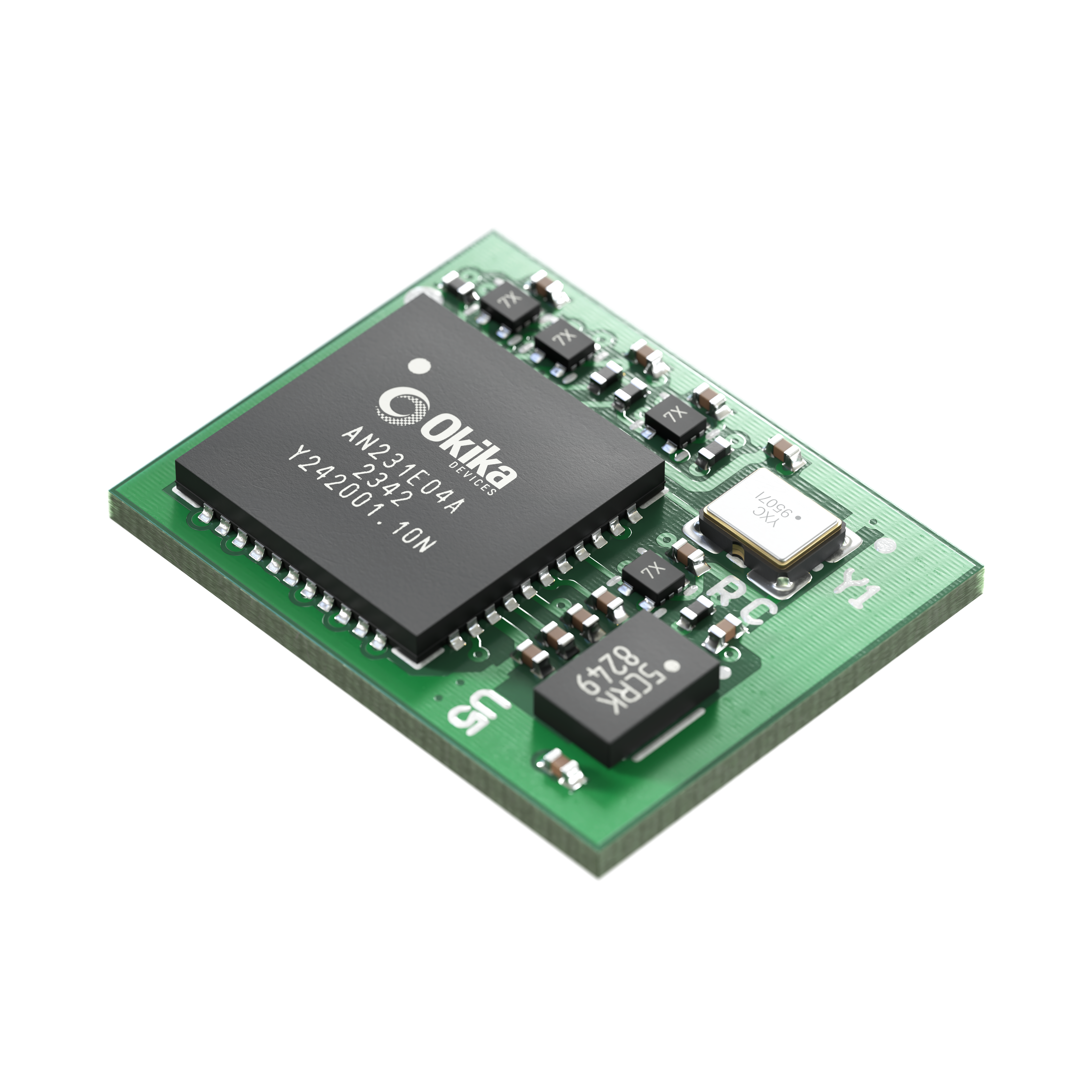
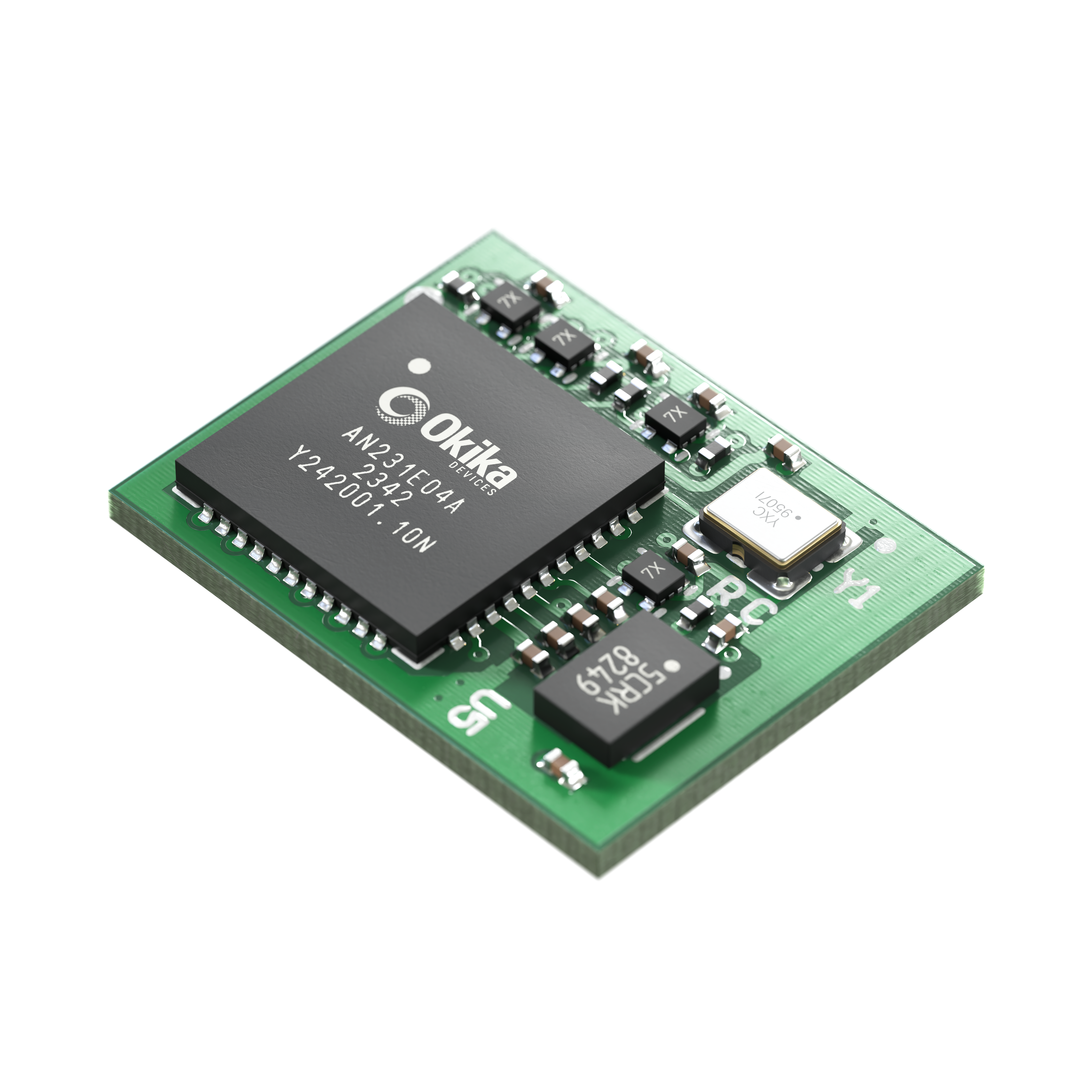
Colorado Springs, CO — Okika Devices today announced the launch of its new Chameleon™
product family — a tiny yet powerful analog module that adapts to a wide range of analog
design needs. Each Chameleon™ module integrates an Okika Field Programmable Analog
Array (FPAA) with on-module nonvolatile memory, a precision oscillator, and reconfiguration circuitry — delivering pre-programmed, ready-to-use analog functions in a compact 14 × 11 mm LGA-32 form factor.
Designed for engineers who need analog flexibility without the complexity of firmware or digital control, Chameleon™ modules can operate as fixed-function analog blocks straight out of the box — no microcontroller required. Users can also reprogram configurations in- system or via a standard 3.3V SPI interface, enabling complete customization and rapid iteration.
“With Chameleon™, designers can implement, test, and update analog functions in minutes rather than months,” said Michael Hollabaugh, VP of Sales & Marketing at Okika Devices. “It’s ideal for sensor conditioning, adaptive control, and instrumentation — anywhere flexibility, precision, and speed to market matter.”
Key Advantages
- Design Simplicity: Ships pre-programmed and ready to use — no microcontroller or
firmware needed unless you want in-system reconfiguration. - Custom Optimization: Okika provides application support and custom circuit
configuration tailored to your performance goals. - Compact Size: High-density interconnect (HDI) construction fits full analog
subsystems into a 14 × 11 mm footprint. - Standard Tools: Program using any 3.3 V SPI EEPROM programmer.
- Future-Proof Flexibility: Reconfigure analog functions — such as filters, amplifiers,
PID loops, and oscillators — anytime, without new hardware.
Built on FlexAnalog™ Technology
Each Chameleon™ module leverages Okika’s FlexAnalog™ FPAA architecture — a
reconfigurable analog matrix featuring over 40 configurable analog modules (CAMs)
including filters, amplifiers, oscillators, and more. Designers can simulate and verify
performance instantly using Anadigm Designer 2 software with precise parameter tuning
and filter design tools.
Applications
- Programmable active filter networks
- Sensor signal conditioning and linearization
- Industrial automation and adaptive control
- Research and rapid prototyping
About Okika Devices
Okika Devices is a leader in adaptive and reconfigurable analog solutions, empowering
engineers to innovate faster with tools that blend flexibility, precision, and performance.
With Chameleon™, Okika extends its FlexAnalog™ platform into a ready-to-use form factor
that adapts as effortlessly as its name suggests.
Media Contact:
Michael Hollabaugh
VP, Sales & Marketing