Modern embedded systems can process signals in several places. Some functions can be implemented in analog hardware before conversion. Others are better performed after an ADC by a microcontroller, DSP, FPGA, or application processor.
The correct architecture is rarely a choice between analog and digital as mutually exclusive alternatives. It is a decision about where each operation provides the greatest system-level value.
Every digital-centered signal chain still requires a minimum analog front end. Before a signal reaches the ADC, it may need protection, attenuation, amplification, level shifting, filtering, buffering, or differential conversion. The architectural choice is therefore not whether analog circuitry is needed, but how much functionality the analog front end should provide and whether that functionality must be reconfigurable.
Several implementation options are available:
- A fixed analog front end built from discrete amplifiers, filters, comparators, and passive components
- A programmable analog-front-end IC with digitally adjustable gain, filtering, multiplexing, or sensor excitation
- An integrated ADC that includes functions such as a programmable-gain amplifier, input multiplexer, reference buffer, digital filter, comparator, or sensor interface
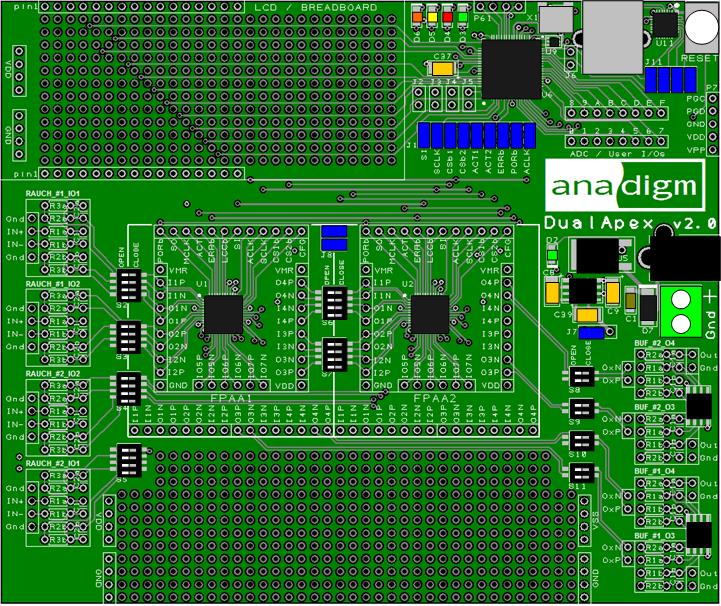
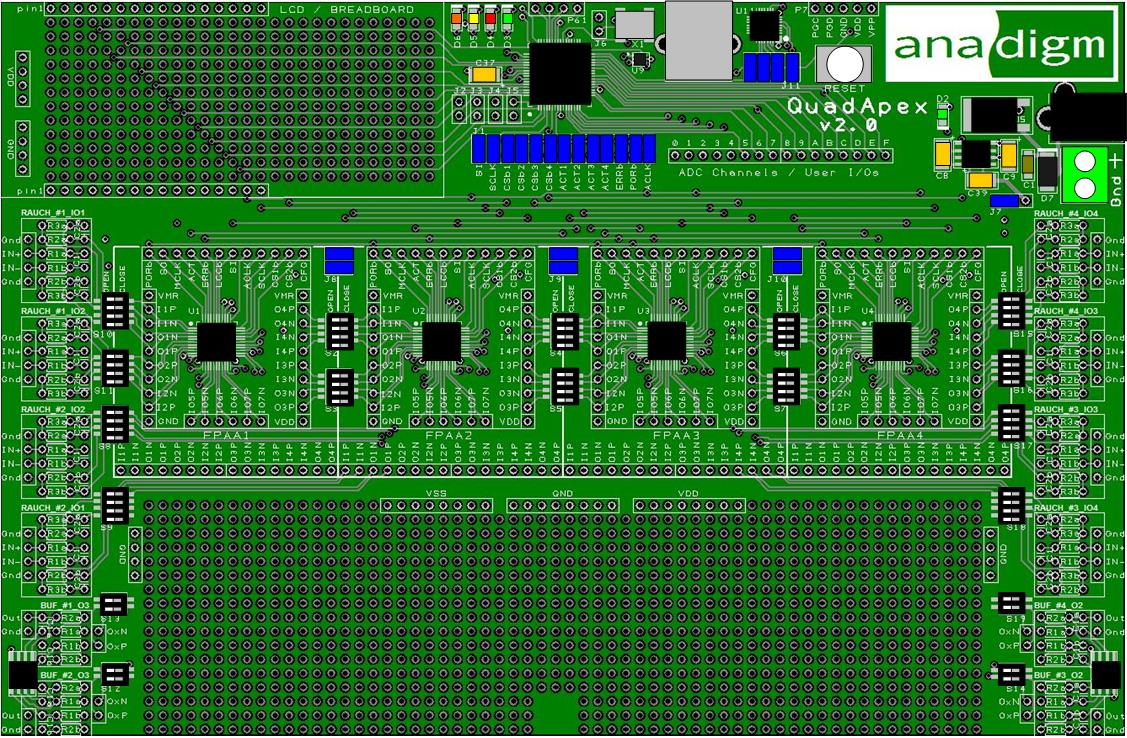
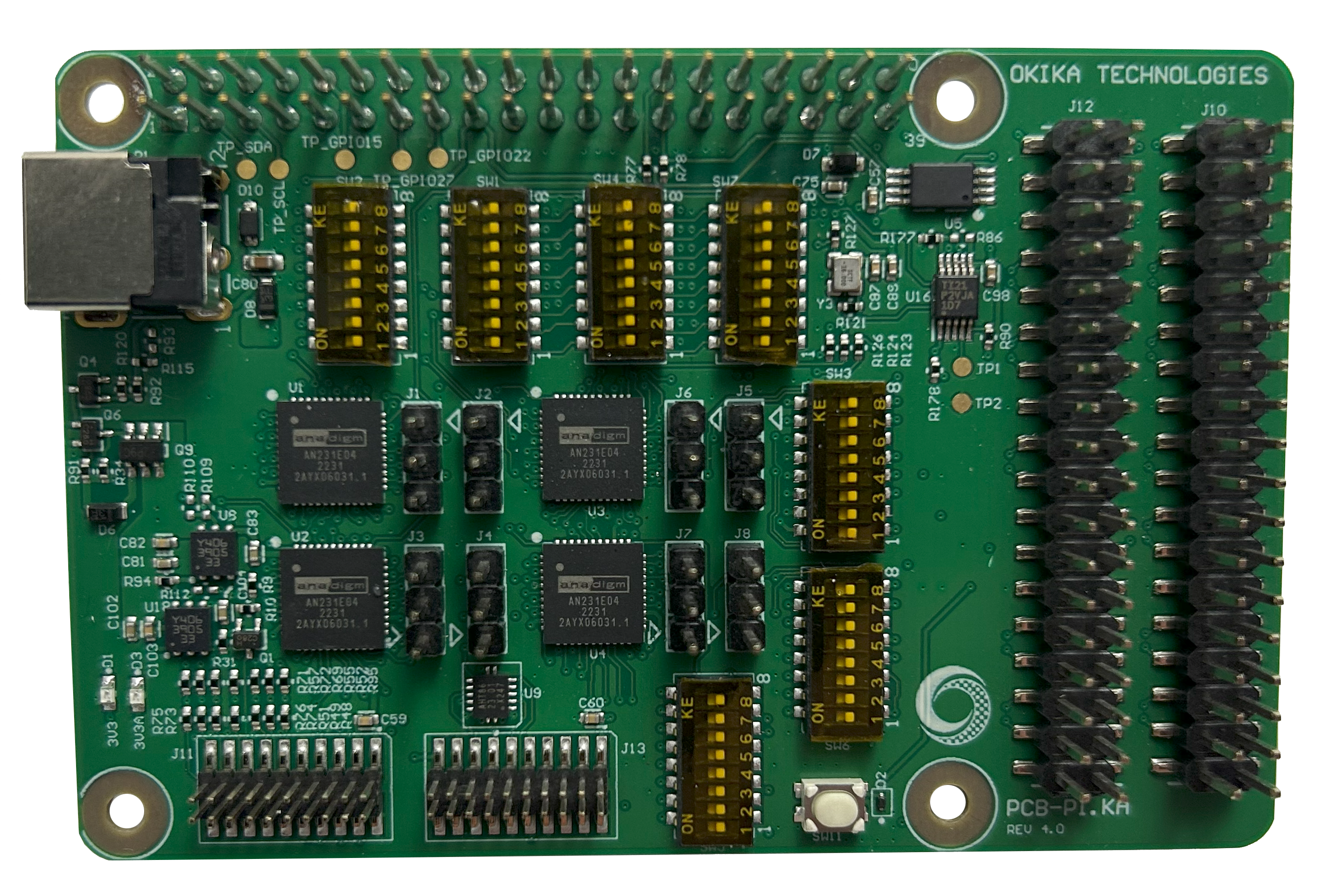
- A field-programmable analog array, or FPAA, that implements reconfigurable analog functions and routing
- A minimal analog front end followed by a higher-performance ADC and more extensive digital processing
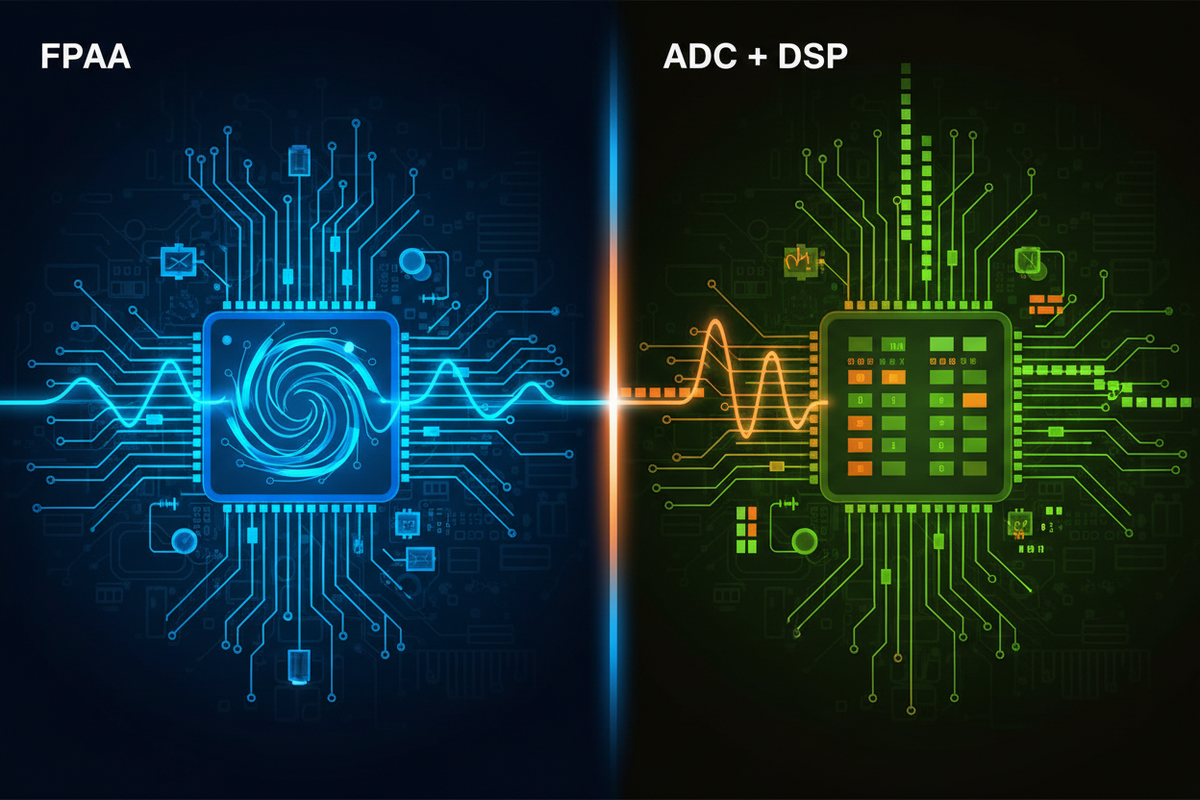
An FPAA adds a broadly reconfigurable option on the analog side of the conversion boundary. It can perform functions such as gain, filtering, comparison, integration, signal generation, and routing before the signal is digitized. An ADC and DSP architecture converts the conditioned waveform into numerical samples and performs subsequent algorithms in software or digital logic.
Both approaches are flexible, but they are flexible in different ways.
What must happen before the ADC
Several signal-chain tasks are inherently analog because they determine what reaches the converter.
Input protection and voltage translation
An ADC can accept signals only within its electrical limits. Attenuation, clamping, level shifting, common-mode control, and differential conversion must occur before conversion. Software cannot correct an input that exceeded the converter range or violated its common-mode limits.
Gain and dynamic-range utilization
Digital gain can multiply converted values, but it cannot recover converter codes that were never used. A small signal should often be amplified before the ADC so that it occupies a meaningful portion of the input range. Conversely, a large signal may require attenuation to avoid clipping.
This gain may be provided by a fixed amplifier, a programmable-gain amplifier, an integrated ADC input stage, a programmable AFE, or an FPAA. The best implementation depends on the number of required gain ranges, the accuracy target, the bandwidth, and whether the gain must change during operation.
Anti-alias filtering
Signals and noise above the usable sampled bandwidth can fold into the digital band. Once aliasing occurs, the resulting frequency component is embedded in the sampled data and generally cannot be separated reliably from a legitimate in-band signal.
Most sampled systems therefore require sufficient analog bandwidth limiting before conversion. That filtering may be provided by the sensor itself, an external RC or active filter, a programmable AFE, an FPAA, an ADC’s integrated analog input network, or a combination of these elements.
The amount of external filtering required depends on the complete sampling architecture. Oversampling, an ADC’s internal filters, a naturally band-limited sensor, and a large separation between signal bandwidth and sampling rate can reduce the required external filter order. They do not eliminate the need to understand what unwanted energy can reach the converter and where it will appear after sampling.
Source buffering and ADC drive
The sensor or preceding filter must be able to drive the ADC input and settle within the acquisition time. Buffering, impedance transformation, and charge delivery are analog interface functions.
These tasks define a minimum analog front end for a digital-centered system. The architecture question is whether that front end should be:
- Fixed for one operating condition
- Adjusted through digitally controlled amplifiers, switches, or filters
- Implemented with a dedicated programmable AFE
- Integrated partly or fully into the ADC
- Made more broadly reconfigurable with an FPAA
What digital processing does best
After conversion, DSPs and other digital processors provide capabilities that are difficult or inefficient to reproduce in analog hardware.
Digital processing is generally the stronger choice for:
- Complex arithmetic and high-precision numerical operations
- Long finite-impulse-response filters
- Fast Fourier transforms and spectral analysis
- Machine-learning inference
- Communications protocols and data formatting
- Storage, compression, encryption, and networking
- Algorithms that change frequently or require large memory
- Operations that combine many channels or historical samples
Digital systems are also highly repeatable. Once the signal has been converted accurately, the same numerical operation produces predictable results across devices and environmental conditions.
The tradeoff is that digital processing begins only after acquisition. The system must sample, convert, transfer, buffer, and process the data. Those steps consume power, create data movement, and introduce delay. The impact may be negligible in a slow sensor system, but it can matter in always-on, high-channel-count, high-bandwidth, or low-latency applications.
What an FPAA changes
A conventional analog front end is often designed as a fixed network of op amps, resistors, capacitors, comparators, and switches. A programmable AFE may allow engineers to adjust selected parameters such as gain, channel routing, sensor excitation, or filter settings. An integrated ADC may provide similar functions within the converter package.
An FPAA can provide a broader level of analog configurability by moving multiple signal-processing functions into configurable analog blocks and programmable routing.
The signal remains analog, but configuration data determines how it is processed. Depending on the device and design, engineers may be able to change parameters such as gain, cutoff frequency, routing, or circuit topology without replacing the board.
This creates a useful middle layer between the sensor and the digital processor. The FPAA can condition the waveform, select relevant information, extract analog features, or create event-driven outputs before the ADC, while the DSP performs calculations that benefit from digital precision, memory, and programmability.
How analog preprocessing can reduce data
Analog preprocessing does not automatically reduce data simply because it occurs before the ADC. Applying gain or filtering to a continuously sampled waveform may improve signal quality without reducing the number of samples generated.
Data reduction occurs when the analog stage changes what must be digitized, how often it must be digitized, or how many channels must be converted. This can happen in several ways.
Bandwidth reduction
An analog low-pass or band-pass filter can isolate the frequencies relevant to the application. If the remaining signal bandwidth is lower, the system may be able to use a lower ADC sample rate while still satisfying the sampling requirements.
For example, a sensor may generate useful content below 500 Hz along with noise extending to tens of kilohertz. Removing the high-frequency energy before conversion may allow the system to sample and process a much narrower band.
Channel selection and routing
A configurable analog stage can select one signal, sensor, or frequency path from several available inputs. Instead of continuously digitizing every channel at full rate, the processor can configure the analog path to acquire only the channel needed for the current operating mode.
This reduces ADC throughput when simultaneous raw data from every channel is not required.
Analog feature extraction
The analog stage can transform a high-bandwidth waveform into a lower-bandwidth measurement such as:
- An amplitude envelope
- An integrated energy value
- A peak level
- A threshold crossing
- A zero-crossing rate
- A band-specific response
- A rectified or averaged signal
The ADC can then digitize the extracted feature rather than the complete original waveform.
This can greatly reduce data volume, but it also removes information. Once the waveform has been rectified, integrated, thresholded, or reduced to an envelope, the original raw signal may no longer be recoverable.
Event-driven acquisition
An analog comparator or detection circuit can monitor a signal continuously while the ADC and processor remain inactive or operate at a lower duty cycle. When the signal crosses a threshold or matches a selected condition, the analog stage can wake the digital system or trigger high-rate acquisition.
This is particularly useful in always-on systems where relevant events are infrequent.
Analog multiplexing or aggregation
Several sensor signals may be routed sequentially through a shared signal-conditioning path and ADC. In some cases, analog operations can also combine or summarize signals before conversion.
This can reduce converter count or total data throughput, although it may sacrifice simultaneous sampling and must account for switching and settling time.
Analog data reduction is therefore most valuable when the system does not need to preserve every raw waveform continuously. When full-band data is required for later diagnostics, model development, or forensic analysis, extensive pre-conversion reduction may be inappropriate.
Architecture comparison
| Design question | Fixed analog front end | Programmable AFE or integrated ADC | FPAA before ADC | Minimal AFE + ADC and DSP |
|---|---|---|---|---|
| Can it prevent clipping and aliasing? | Yes, for its intended signal range | Yes, using its built-in gain and filters | Yes, within the FPAA’s limits | Only through the analog front end; DSP cannot fix clipping or aliasing later |
| Can software change the analog behavior? | Very little | Yes, within built-in settings | Yes, within available blocks and routing | Very little before conversion; extensively after conversion |
| Can it perform complex calculations? | No | Very limited | Limited | Yes |
| Can it reduce data before conversion? | Yes, if designed to do so | Sometimes | Yes, through filtering, channel selection, feature extraction, or event detection | Usually not; most reduction happens after conversion |
| Does it require continuous ADC sampling? | Not always | Not always | Not always | Usually, unless the analog front end detects events or selects channels |
| Is performance consistent across units? | Depends on components and calibration | Generally consistent, but still affected by analog tolerances | Generally consistent, but calibration may be needed | Highly consistent after accurate conversion |
| Can it be updated after deployment? | Usually limited | Yes, within available settings | Yes, depending on the device and system | Yes for digital processing; limited for the analog front end |
| How much can the analog circuit change? | Very little | Limited to built-in functions | Broadly, within available blocks and routing | Very little before conversion |
There is no universal winner. The table illustrates why hybrid systems are common and why programmable AFEs, integrated ADCs, FPAAs, and digital processors should be viewed as points along an architectural spectrum rather than isolated alternatives.
Example 1: Vibration monitoring
A vibration sensor may produce a wide-band signal containing machine motion, resonances, electrical interference, and events outside the frequencies relevant to a specific fault.
A digital-centered approach can use a conventional or integrated analog front end, sample the complete waveform at a high rate, and apply digital filters or spectral analysis. This is appropriate when the system needs full-band data or complex diagnostics. It also increases conversion, storage, transfer, and processing requirements across every monitored channel.
A programmable AFE or integrated ADC may provide selectable gain, channel multiplexing, and predefined filter settings. This can be sufficient when only a limited number of operating ranges are required.
A hybrid FPAA architecture can provide programmable gain, band selection, routing, envelope detection, or event detection before conversion. The processor can switch the analog response for different machine states or diagnostic modes.
For example, the system might:
- Monitor a narrow vibration band continuously
- Generate a low-bandwidth envelope or energy measurement
- Trigger the processor when that measurement exceeds a threshold
- Reconfigure the analog path for wider-band acquisition
- Capture the raw waveform only during the suspected fault event
This can reduce continuous ADC and processor activity without preventing detailed digital analysis when it is needed.
The best choice depends on whether full raw waveform retention is required. Analog preprocessing should not remove information that later analysis needs.
Example 2: Robotic control
A control system may need to filter sensor noise, scale feedback signals, detect limits, and respond to changes quickly. A digital controller can perform sophisticated control laws, but its total loop delay includes ADC conversion, data transfer, computation, and output update.
Moving every operation into analog is rarely practical, especially when the control algorithm is complex. However, analog preprocessing can reduce noise, normalize the signal range, and create fast threshold or protection paths before the digital controller.
A programmable AFE or integrated ADC may provide sufficient gain selection and input monitoring for systems with a small number of defined modes. An FPAA may be more appropriate when filter response, compensation, routing, or threshold behavior must change more extensively across loads and operating conditions.
The result is not analog instead of digital. It is an architecture in which time-critical signal preparation and protection occur close to the sensor while higher-level control remains digital.
Example 3: Multi-mode sensing
A platform that uses the same sensor across several modes may need different bandwidths and gain ranges. A fixed front end must be designed for the worst case, duplicated for each mode, or supplemented with switched components.
A programmable-gain amplifier, programmable AFE, or integrated sensor ADC may be the simplest solution when the system only needs to choose among predefined gains, channels, or filter responses.
A DSP can apply different digital filters, but the ADC must still accommodate the analog range and bandwidth reaching its input. Digital filtering cannot recover a signal that clipped or remove an aliased component that entered the sampled band.
An FPAA can reconfigure the front end before conversion. A low-noise, narrow-band mode might use higher gain and stronger filtering, while a fast-transient mode uses lower gain and greater bandwidth. The ADC and processor receive a signal that has already been adapted to the current operating condition.
The decision depends on how many parameters must change and whether the required configurations can be provided by a simpler programmable AFE or integrated ADC.
Questions that determine the correct split
When selecting an architecture, ask:
- Which information must be preserved for later digital analysis?
- What is the highest required signal bandwidth?
- What unwanted frequencies and noise sources can reach the ADC?
- Where is the required analog bandwidth limiting provided?
- What sample rate and ADC resolution are needed?
- How much latency can the system tolerate?
- How many channels must operate continuously?
- Can the analog operating range or filter requirements change?
- Are predefined gain and filter settings sufficient, or must the analog topology change?
- Could a programmable AFE or integrated ADC meet the requirements?
- Is full raw data required, or can the signal be reduced before conversion?
- If the signal is reduced, which information will no longer be recoverable?
- What power and data-transfer budget is available?
- Which functions require numerical precision or memory?
- Which failures must be detected even if the digital processor is delayed or unavailable?
These questions are more useful than asking whether analog or digital processing is better in general.
A practical hybrid partition
Fixed, programmable, integrated, or FPAA analog stage
- Protection and input translation
- Gain and attenuation
- Common-mode control
- Anti-alias filtering
- Band selection
- Input multiplexing and routing
- Signal rectification or integration
- Envelope or peak detection
- Fast threshold detection
- Event-trigger generation
- Sensor calibration or mode-dependent conditioning
- ADC buffering and drive
ADC and digital stage
- Precision numerical filters
- Spectral analysis
- Sensor fusion
- Control algorithms
- Classification and machine learning
- Data logging and communications
- User interfaces and system management
Not every application requires an FPAA. A fixed front end is often the simplest option when the signal conditions are stable. A programmable AFE or integrated ADC may be preferable when the system needs only a few selectable gain ranges, channels, or filter modes. An FPAA becomes more attractive when the pre-conversion signal path requires broader reconfiguration than those devices can provide.
The exact boundary should remain visible in the system specification. Problems often arise when the analog front end is treated as a minor interface and the processor is expected to compensate for every limitation later.
Design for the information flow
An FPAA does not replace an ADC or DSP. It expands the set of operations that can be configured before conversion. Under the right conditions, this can reduce latency, improve dynamic-range utilization, lower unnecessary data movement, support event-driven acquisition, and allow the analog front end to adapt with the rest of the system.
A programmable AFE or integrated ADC may provide many of the same benefits when the required analog behavior fits within its predefined functions. An FPAA is most valuable when engineers need greater control over analog routing, processing, or topology before conversion.
The strongest architectures assign each function to the domain where it is most effective. Use analog processing to protect, preserve, and appropriately limit the signal before sampling. Use digital processing for complex, repeatable algorithms after conversion. Use programmable or reconfigurable analog hardware when the pre-conversion signal chain must change without a hardware redesign.