Analog FPGA Explained: What Is an FPAA?
Engineers often search for an “analog FPGA” when they want the flexibility of programmable hardware in the analog signal domain. The established technical term for this class of device is a Field-Programmable Analog Array, or FPAA.
An analog FPGA is best understood as a Field-Programmable Analog Array (FPAA): an integrated circuit with configurable analog resources and programmable signal routing. An FPGA configures digital logic; an FPAA configures analog circuitry.
What Does “Analog FPGA” Mean?
The phrase analog FPGA is an intuitive way to describe programmable analog hardware. It is useful because many engineers already understand what an FPGA does for digital systems: the chip is manufactured first, while much of its application-specific behavior is defined later through configuration.
An FPAA extends a similar idea into the analog domain. Instead of fixing every amplifier, filter, comparator, integrator, and signal path when a PCB or custom IC is designed, an FPAA provides analog resources whose functions and connections can be configured after manufacturing.
This is not simply marketing terminology. A 1991 IEEE paper by E. K. F. Lee and P. Glenn Gulak described a CMOS field-programmable analog array built from configurable analog blocks connected through a programmable interconnection network.[1] Later FPAA research expanded the concept toward larger analog and mixed-signal programmable systems.[2]
FPGA
Configures digital hardware resources to implement logic, state machines, arithmetic, digital signal processing, interfaces, and other digital functions.
FPAA
Configures analog computational resources and signal paths to implement functions such as filtering, gain, comparison, integration, summing, waveform generation, and analog preprocessing.
That is why “analog FPGA” is a useful analogy, while FPAA is the more precise technical term.
New to Field-Programmable Analog Arrays?
Okika's Discover FPAA resource provides a broader introduction to programmable analog technology, development platforms, products, and use cases.
Discover FPAA TechnologyFPGA vs. FPAA: Similar Idea, Different Signal Domain
An FPGA and an FPAA share an important principle: both allow application-specific hardware behavior to be configured after the silicon has been manufactured. What changes is the type of hardware being configured.
- Digital logic resources
- Digital interconnect
- Binary signals
- Logic, arithmetic, and digital processing
- Analog computational resources
- Analog signal routing
- Continuous electrical signals
- Filtering, gain, and analog computation
| Characteristic | FPGA | FPAA / “Analog FPGA” |
|---|---|---|
| Primary domain | Digital | Analog |
| Core resources | Logic blocks, LUTs, registers, DSP resources | Configurable analog blocks and functional resources |
| Routing | Programmable digital interconnect | Programmable analog interconnect |
| Typical functions | Logic, state machines, arithmetic, digital DSP | Filtering, amplification, integration, comparison, analog computation |
| Field configurable | Yes | Yes |
| Processes analog signals directly | Not through the digital logic fabric | Yes |
For a more detailed engineering discussion of the differences, tradeoffs, power considerations, and complementary roles of the two technologies, see FPAA vs FPGA: Power-Efficient Analog Flexibility for Embedded Systems .
What Changes When the Hardware Is Analog?
The most important distinction is not simply what blocks appear on a chip. It is where signal processing occurs.
A conventional embedded signal chain often conditions a physical signal with fixed analog circuitry, converts that signal into digital data with an ADC, and then performs more complex processing in an MCU, DSP, or FPGA.
An FPAA can make a substantial part of the analog front end programmable:
Filtering, amplification, comparison, integration, threshold detection, and other supported functions can therefore operate on the electrical signal itself before it is represented as digital samples.
Does an FPAA Replace the ADC?
Usually not. An ADC and an FPAA have different jobs. An ADC converts an analog signal into digital data. An FPAA performs configurable operations in the analog domain.
The two can work together. For example, an FPAA can provide programmable gain and filtering before an ADC, allowing the downstream converter and processor to receive a signal that has already been appropriately conditioned.
For a deeper discussion of this application, see FPAAs for Sensor Interfaces and ADC Signal Conditioning .
What Is Actually Programmable in an FPAA?
FPAA architectures vary, so there is no single block diagram that represents every device. That distinction matters: FPAA describes a class of programmable analog hardware, not one universal circuit architecture.
Most FPAA concepts nevertheless rely on two fundamental capabilities.
Configurable Analog Resources
Physical analog resources can be configured to perform supported functions such as gain, filtering, summing, integration, comparison, oscillation, signal detection, and other operations.
Programmable Analog Routing
Configurable interconnection determines how I/O resources and analog blocks connect. Changing the routing can therefore change the actual analog signal path and circuit topology.
Research literature has explicitly compared this design philosophy with FPGA architecture. Hall, Hasler, and Anderson described an FPAA architecture analogous to FPGA architectures for configurable analog signal-processing systems.[4]
A Commercial Example: The AN231E04
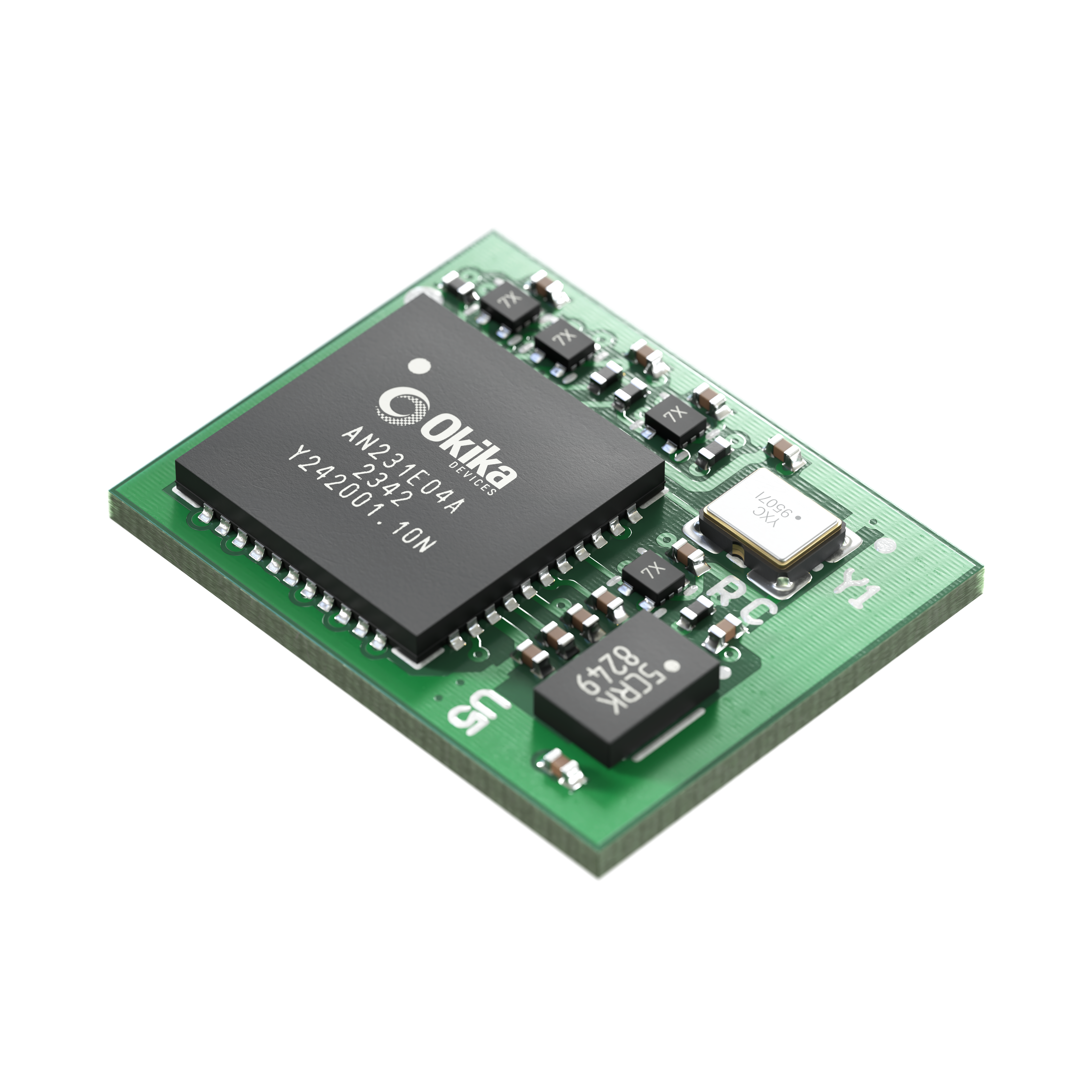
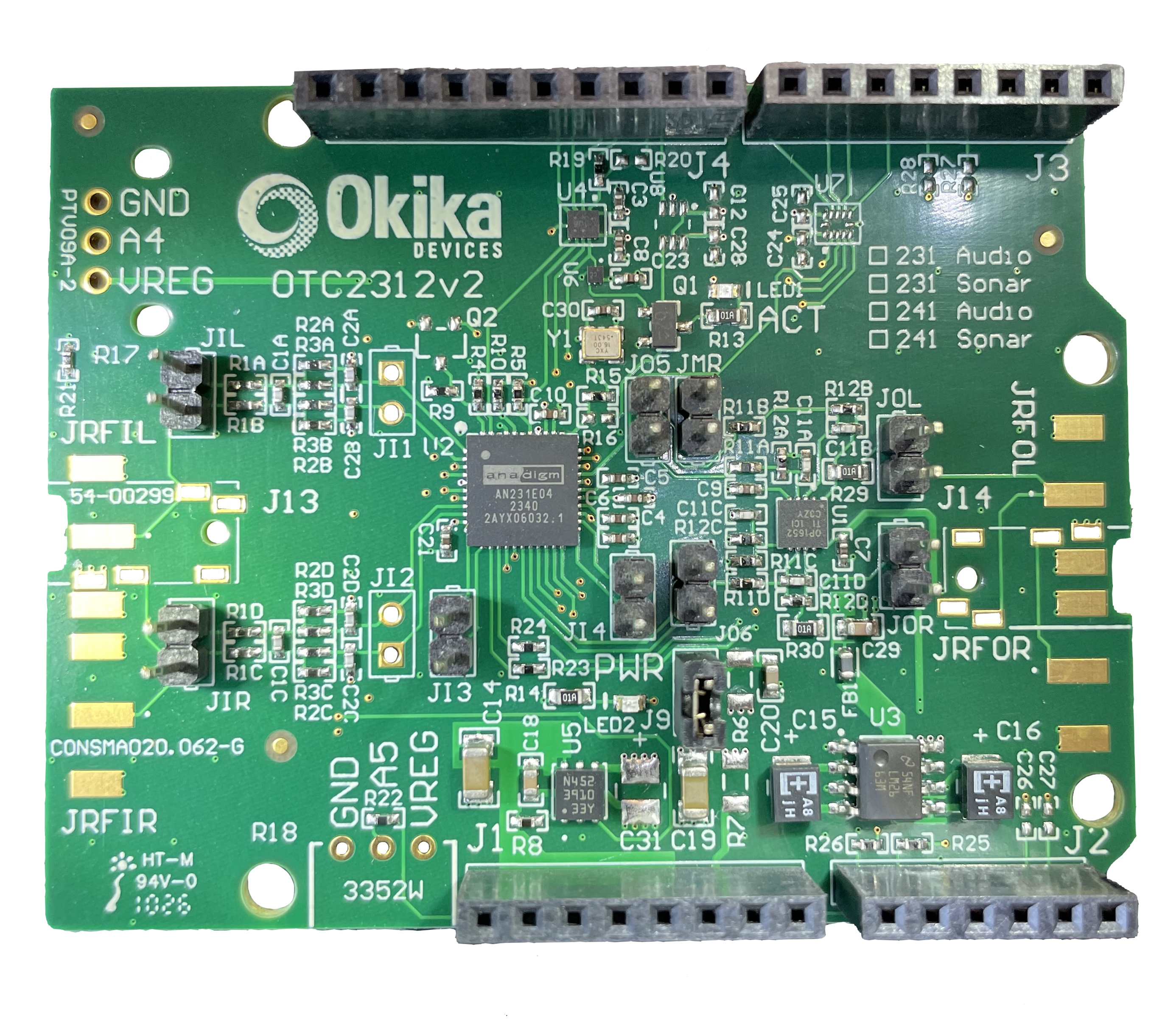
The Okika AN231E04 provides a practical example of a commercial FPAA.
The device contains four Configurable Analog Blocks arranged in a 2 × 2 matrix, programmable routing, configurable analog I/O resources, and a lookup table. Its resources can be configured to implement functions including filtering, amplification, summing, comparison, waveform generation, and nonlinear operations.
The point is not that every FPAA looks like the AN231E04. Rather, it makes the “analog FPGA” concept tangible: a manufactured IC contains analog hardware whose functional behavior and interconnections can be configured for a particular application.
Where the “Analog FPGA” Analogy Breaks Down
The analogy is useful for understanding programmability, but an FPAA should not be treated as an FPGA with analog replacements for digital logic gates.
An FPAA implements a real analog circuit. The resulting design is therefore governed by analog behavior, including:
- Signal amplitude and headroom
- Bandwidth
- Noise
- Offset
- Distortion
- Dynamic range
- Loading
- Routing parasitics
- Bias conditions
- Architecture-specific sampling behavior
Configuration software can simplify circuit implementation, but it cannot make those physical characteristics disappear.
Engineers moving from digital programmable logic into FPAAs should therefore expect a mixture of familiar concepts, including configurable blocks, routing, configuration, and reusable functions, alongside traditional analog engineering constraints.
Okika's Common First-Time FPAA Design Mistakes and How to Avoid Them explores this transition in more practical detail.
Is an FPGA Connected to an ADC an Analog FPGA?
No. A conventional FPGA can certainly be part of a mixed-signal system, and FPGA platforms can include or connect to ADCs, DACs, comparators, PLLs, and other analog or mixed-signal components.
The distinction is what happens inside the programmable fabric.
Convert First, Process Digitally
The ADC samples an analog waveform and turns it into digital values. The FPGA then performs calculations on that digital representation.
Process in the Analog Domain
The electrical signal itself passes through configurable analog circuitry. Supported operations occur before, alongside, or sometimes without full analog-to-digital conversion.
Neither approach is universally better. They solve different problems and are often strongest when used together.
FPAA + FPGA + MCU: Programmable Hardware Across Domains
Thinking of FPAAs and FPGAs only as competitors misses an important architectural opportunity. A system can assign work according to the domain where it makes the most sense.
FPAA Responsibilities
Analog signal conditioning, filtering, gain control, comparison, analog preprocessing, and other functions that operate directly on the physical signal.
FPGA / MCU Responsibilities
Digital logic, high-speed parallel computation, communications, control, sequencing, data processing, software, and system management.
The correct partition depends on bandwidth, latency, accuracy, power, data rate, available resources, and the requirements of the individual system.
For practical implementation considerations, see Integrating FPAA Designs with MCU and FPGA Systems .
Why Programmable Analog Matters at the Sensor Boundary
As embedded systems become more data-intensive, an important architectural question is not only how a signal should be processed, but where that processing should begin.
A digital-first architecture may sample a broad stream of sensor data and then perform filtering, detection, or feature extraction downstream. A programmable analog architecture creates the option to perform selected signal-facing operations before all of that information becomes digital data.
Depending on the application, this can be useful for filtering unwanted signal content, adjusting gain, detecting thresholds, extracting selected features, or otherwise preparing information closer to the source.
This does not eliminate the need for digital computing. Instead, it creates another point at which system architects can decide how work should be divided between analog and digital processing.
FPAA Processing at the Edge
Explore how programmable analog can move selected signal processing closer to the sensor boundary in edge AI and embedded sensing architectures.
Read the Edge AI ArticleFrom Analog FPGA to System-on-Chip FPAA
The “analog FPGA” description becomes less complete as FPAA architectures grow into larger mixed-signal systems.
Large-scale FPAA research has explored architectures that combine programmable analog computation with configurable digital resources, embedded processors, memory, converters, routing, and software infrastructure.[2]
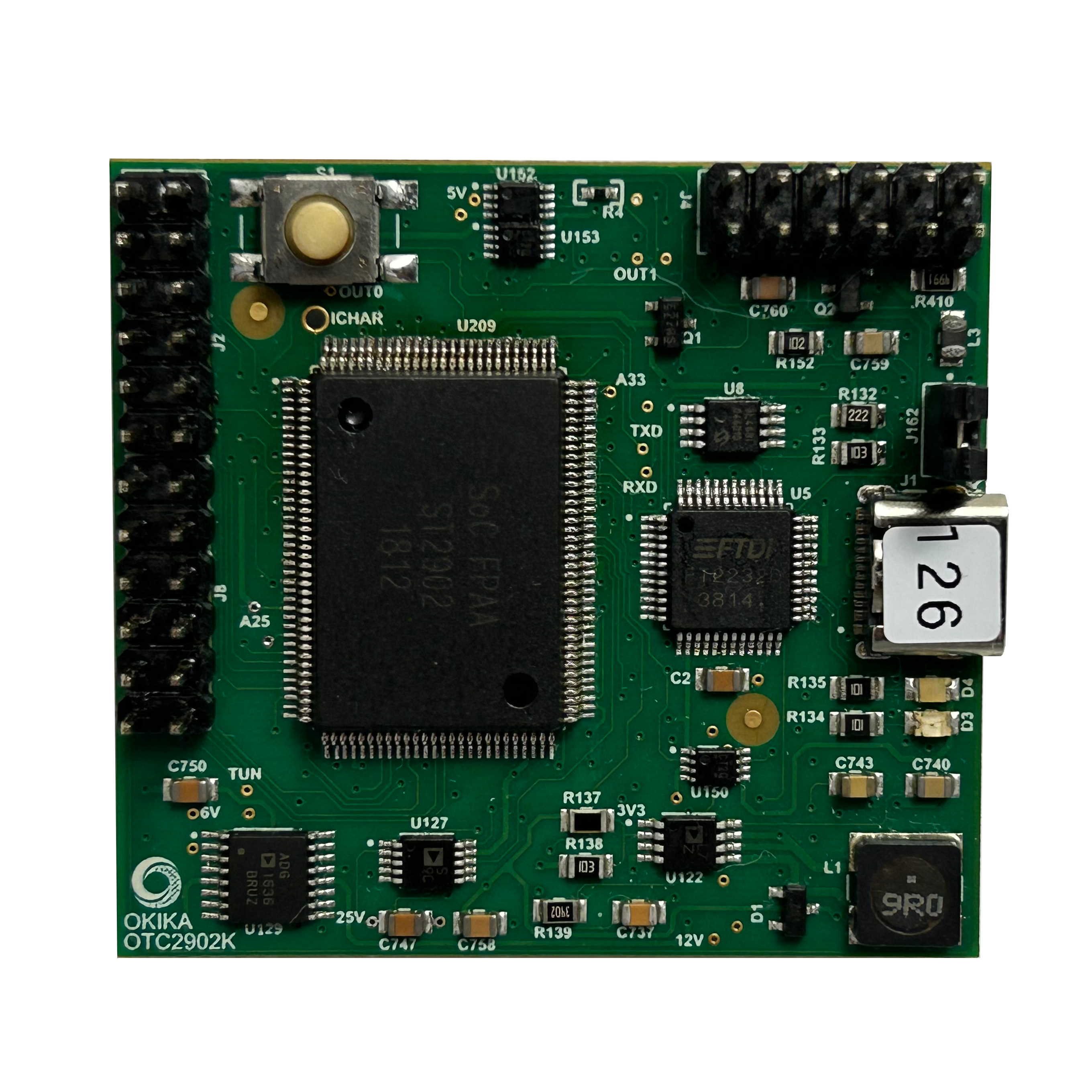
A published FPAA system-on-chip has, for example, integrated programmable analog and digital resources with an embedded 16-bit MSP430 processor and mixed-signal interfaces.[3]
At that scale, the architecture is better understood as a reconfigurable mixed-signal computing platform rather than simply an analog version of an FPGA.
Because Okika already maintains a dedicated technical resource for this subject, the detailed architecture, programming workflow, research history, design resources, and application material are not repeated here.
Explore System-on-Chip FPAAs
Visit the dedicated SoC FPAA page for architecture details, programmable analog and digital resources, design and programming workflows, applications, technical papers, videos, workshops, and research material.
Explore the SoC FPAA Technical Resource LibraryWhen Does an “Analog FPGA” Make Sense?
FPAAs are not intended to replace every fixed analog circuit. A simple, stable, high-volume function may still be best served by dedicated analog components or a purpose-built IC.
Programmable analog becomes particularly valuable when the ability to change the analog hardware has system-level value.
- Signal-conditioning requirements may change
- One platform must support multiple sensors
- Filter or gain settings vary between operating modes
- Analog prototypes require frequent iteration
- Products need field-configurable analog behavior
- Hardware must support multiple product variants
- Selected preprocessing belongs before digitization
- Analog and digital programmable hardware must work together
Potential application areas include sensor interfaces, instrumentation, robotics, industrial systems, control, audio, biomedical electronics, aerospace and defense systems, research, education, adaptive signal processing, and edge sensing.
The more useful engineering question is often not “Can an FPAA replace this analog circuit?” but rather:
Would making this part of the analog signal chain programmable improve development, adaptability, integration, or operation of the overall system?
One Idea, Different Reasons to Care
A Reconfigurable Analog Design Tool
FPAAs add programmable filters, gain stages, signal paths, and other analog functions to the embedded hardware toolbox.
A Platform for Analog and Mixed-Signal Computing
FPAA platforms provide a way to investigate configurable analog architectures, neuromorphic systems, mixed-signal computation, sensing, controls, and other research areas without developing a new IC for each experiment.
More Adaptable Hardware
Programmable analog can help one hardware platform support changing requirements, product variants, different sensors, and iterative development.
Programmability Beyond Software and Digital Logic
FPAAs extend the idea of post-manufacturing configurability into a part of the system that has traditionally remained fixed: the analog signal path.
Analog FPGA and FPAA FAQ
Is there such a thing as an analog FPGA?
Yes, conceptually. The established technical term is Field-Programmable Analog Array (FPAA). FPAAs provide configurable analog resources and programmable signal routing in a way that is conceptually analogous to the configurable digital hardware found in FPGAs.
What is the analog equivalent of an FPGA?
A Field-Programmable Analog Array, or FPAA, is generally the closest analog counterpart to an FPGA. An FPGA primarily configures digital logic, while an FPAA configures analog computational resources and signal paths.
What does FPAA stand for?
FPAA stands for Field-Programmable Analog Array. It describes an integrated circuit containing configurable analog resources and programmable interconnections.
Is an FPAA just an FPGA that accepts analog signals?
No. The comparison is useful for explaining field programmability, but the underlying hardware is different. An FPAA implements analog circuits and is subject to analog considerations such as bandwidth, noise, signal range, distortion, loading, and routing effects.
Can an ordinary FPGA process an analog signal directly?
The digital logic fabric of a conventional FPGA operates on digital values. Analog signals normally need to be converted to digital data before that fabric processes them. Some FPGA-based devices and systems include ADCs, DACs, or other mixed-signal resources, but this is different from a programmable analog computational fabric.
Does an FPAA need an ADC?
Not to perform analog processing. An FPAA can operate directly on supported analog signals. An ADC is needed when the system also needs to convert an analog signal or result into digital data.
Can an FPAA work with an FPGA or microcontroller?
Yes. Hybrid systems can use an FPAA for analog preprocessing or signal conditioning, an FPGA for high-speed digital processing, and a microcontroller for configuration, communications, sequencing, or higher-level control.
Is an FPAA the same as a programmable analog front end?
Not necessarily. A programmable analog front end may expose adjustable gain, bandwidth, channel selection, or other parameters while retaining a mostly fixed architecture. An FPAA provides configurable analog resources and programmable interconnection that can allow the implemented analog circuit itself to change.
Can an FPAA be reconfigured after deployment?
Many FPAAs are designed to be configured after manufacturing, and some architectures support dynamic or runtime reconfiguration. The specific capabilities and appropriate reconfiguration method depend on the device.
Are all FPAAs built the same way?
No. FPAA devices differ in analog architecture, routing, configuration technology, bandwidth, scale, available functions, design tools, and intended applications. FPAA is a technology category rather than one specific implementation.
What is a System-on-Chip FPAA?
A System-on-Chip FPAA extends programmable analog hardware with additional system resources such as programmable digital logic, embedded processing, memory, converters, interfaces, and larger-scale routing. Learn more in Okika's System-on-Chip FPAA Technical Resource Library .
Explore FPAA Technology
References
- E. K. F. Lee and P. G. Gulak, “A CMOS Field-Programmable Analog Array,” IEEE Journal of Solid-State Circuits, Vol. 26, No. 12, pp. 1860–1867, 1991. View publication via DOI .
- Jennifer Hasler, “Large-Scale Field-Programmable Analog Arrays,” Proceedings of the IEEE, Vol. 108, No. 8, pp. 1283–1302, 2020. View publication via DOI .
- Suma George, Sihwan Kim, Sahil Shah, Jennifer Hasler, et al., “A Programmable and Configurable Mixed-Mode FPAA SoC,” IEEE Transactions on Very Large Scale Integration (VLSI) Systems, Vol. 24, No. 6, 2016. View publication via DOI .
- Tyson S. Hall, Paul E. Hasler, and David V. Anderson, “Field-Programmable Analog Arrays: A Floating-Gate Approach,” Field-Programmable Logic and Applications (FPL 2002), pp. 424–433. View publication via DOI .